

Blog
As rhythms become more playful, music often starts a beat quickly and then lets it
settle. One rhythm that does this beautifully is the two semiquavers and one
quaver pattern. It feels light at the start and confident at the end.
What Is Two Semiquavers and One Quaver?
This rhythm is made up of:
• Two semiquavers, followed by
• One quaver
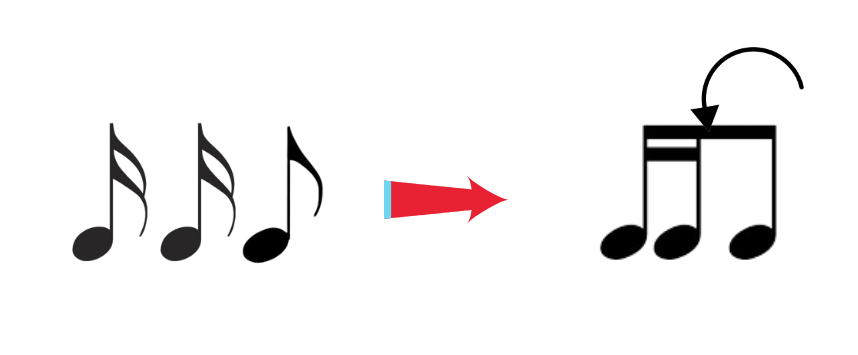
Together, they fill one complete beat in simple time.
• UK (British) name: Semiquaver – Semiquaver – Quaver
• US (American) name: Sixteenth Note – Sixteenth Note – Eighth Note
How the Beat Is Divided
In this pattern:
• Each semiquaver lasts ¼ of a beat
• The quaver lasts ½ of a beat
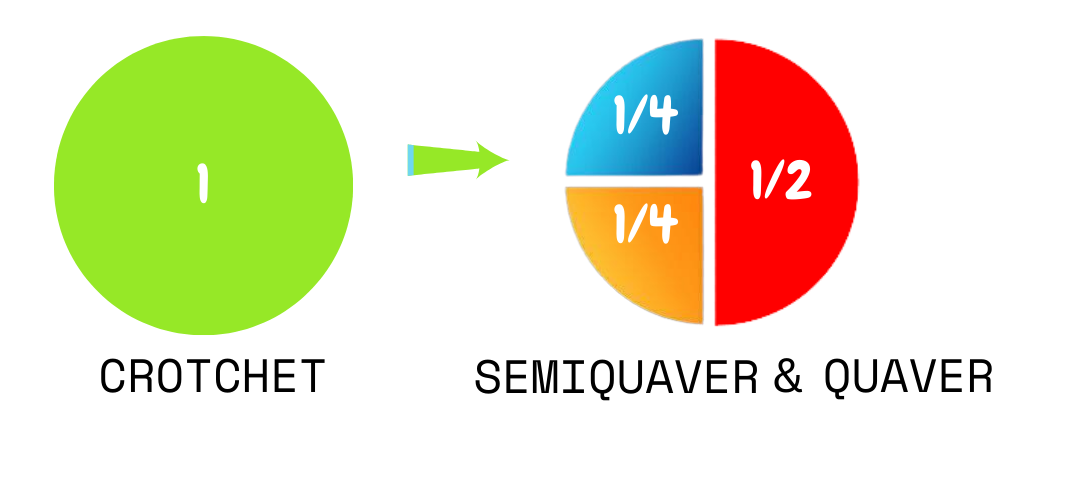
So the maths looks like this:
0.25 + 0.25 + 0.5 = 1 full beat
This creates a short–short–long feeling within a single beat.
How It Looks on the Music Sheet
When written on the staff:
• The two semiquavers appear with two beams
• The quaver connects with them using a single beam
• All three notes are beamed together, showing they belong to the same beat
This visual grouping helps musicians instantly recognize the rhythm.
How Long Does It Last? (Tempo Explained)
At 60 BPM (where one crotchet lasts 1 second):
• Each semiquaver = 0.25 seconds
• Quaver = 0.5 seconds
• Total pattern length = 1 second
At 120 BPM (where one crotchet lasts 0.5 seconds):
• Each semiquaver = 0.125 seconds
• Quaver = 0.25 seconds
• Total pattern length = 0.5 seconds
The tempo changes, but the rhythmic relationship stays the same.
How It Feels When You Hear It
This rhythm:
• Starts with a quick, light motion
• Ends with a longer note for emphasis
• Feels energetic without being rushed
It is often counted as:
“1 e &”
or simply felt as “short-short-long.”
In Simple Time (4/4, 3/4, 2/4)
• Very common and easy to feel
• Adds variety to straight rhythms
• Often alternates with the reverse pattern (quaver + two semiquavers) for
contrast
In Compound Time (6/8, 9/8, 12/8)
• Can be used across beats
• Often creates syncopation or tension
• Adds rhythmic excitement against the natural triple feel
A Simple Way to Think About It
Imagine a quick tap-tap, followed by a firm step:
• The taps are the two semiquavers
• The step is the quaver
Together, they make one complete and expressive movement.
For a more detailed walkthrough, you can watch the full video tutorial below, where each rhythm pattern is explained and practiced step by step.
The next step is simple—practice.
To help you get comfortable with counting and timing, we’ve created a free rhythm exercise PDF you can practice at your own pace. The exercises are short, clear, and beginner-friendly.
Download the free Rhythm Exercise PDF below and start practicing.
 Beginner Scores