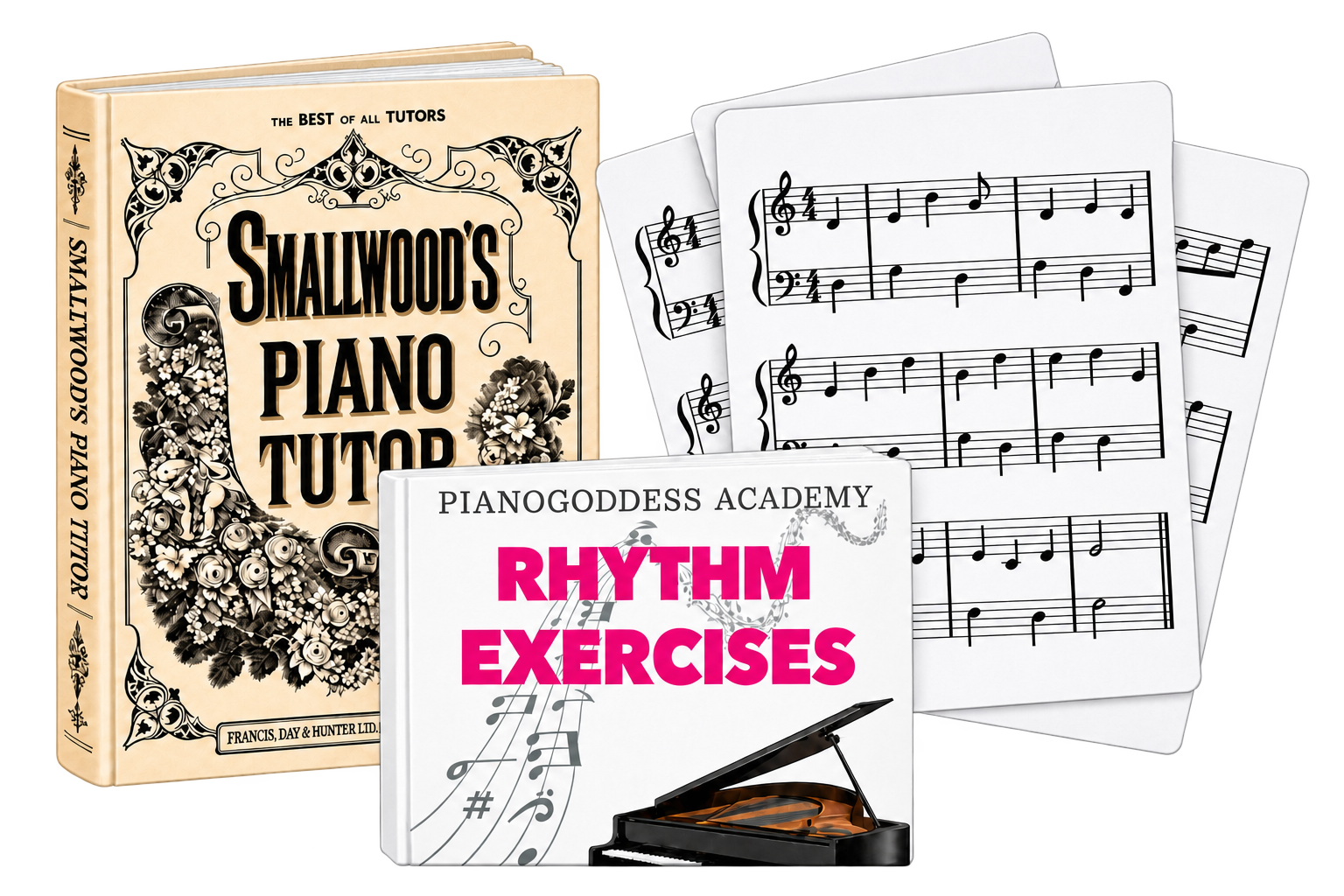
The Fruit Rhythm Course 2
Categories: Online Course
Share
Share Course
Page Link
Share On Social Media
About Course
The Fruit Rhythm Course Part 2 at Pianogoddess Academy is a fun, practical, and progressive approach to learning rhythm and music theory. The course uses familiar fruit words as a simple way to help students understand note values, subdivisions, counting, and rhythmic patterns. Instead of learning rhythm only through abstract musical symbols, students associate different rhythmic values with easy-to-remember fruit words such as “AP-PLE,” “GO,” and “WATER-ME-LON.” This makes rhythm more visual, memorable, and easier to practise.
The course is structured progressively from Grade 1 to Grade 10, allowing students to build their rhythmic knowledge step by step. Each grade introduces new concepts while reinforcing the skills learned in previous levels.
What Students Will Learn
Throughout the course, students progressively develop their ability to:
• Understand basic note values and their duration.
• Recognise and perform different rhythmic patterns.
• Connect written rhythms with spoken fruit words.
• Count and perform rhythms accurately.
• Understand faster note subdivisions.
• Read increasingly complex rhythmic combinations.
• Work with different and more complex time signatures.
• Understand and perform dotted notes.
• Develop confidence with syncopated rhythms.
• Understand and perform triplets.
• Apply theoretical rhythm concepts practically.
The Goal of the Fruit Rhythm Course
The ultimate goal is to help students move from struggling to understand rhythm to confidently reading, counting, and performing it.
By the end of the course, students will have progressed from foundational note values to more complex rhythmic concepts, including dotted notes, syncopation, triplets, faster subdivisions, and complex rhythmic patterns.
The Fruit Rhythm Course turns rhythm into something students can see, say, feel, understand, and perform—creating a stronger foundation for confident musicianship.
What Will You Learn?
- Grade 1 - Introduction to Rhythm
- Grade 2 - Faster Rhythms
- Grade 3 - Time Signatures & Combining Note Values
- Grade 4 - Incorporating Rests
- Grade 5- Dotted Notes
- Grade 6- Triplets
- Grade 7- Advanced Mixed Patterns
- Grade 8- Syncopation and Rest-Based Patterns
- Grade 9- Mastering Complex Rhythms
- Grade 10- Ultimate Mastery
Course Content
Start Here: How to Watch This Course
-
How to View Your Lessons
03:43
Grade 1 – Introduction to Rhythm
Introduce students to the foundations of rhythm using fruit-based
learning.
• Key Learnings:
• Understand and keep a steady beat through clapping and counting
along to simple rhythms.
• Basic note values:
• Crotchet (Quarter Note) - 1 beat
• Quavers (Eighth Notes) - 2 sounds in 1 beat
• Crotchet Rest - silence for 1 beat
• Semibreve (Whole Note) - hold for 4 beats
• Fruit-based mnemonics for learning rhythms (e.g., “AP-PLE | GO | GOL
DEN-ME-LON”)
-
Grade One – Introduction
00:33 -
Grade 1 Exercise 1
00:37 -
Grade 1 Exercise 2
00:37 -
Grade 1 Exercise 3
00:37 -
Grade 1 Exercise 4
00:35 -
Grade 1 Exercise 5
00:35 -
Grade 1 Exercise 6
00:35 -
Grade 1 Exercise 7
00:37 -
Grade 1 Exercise 8
00:36 -
Grade 1 Exercise 9
00:37 -
Grade 1 Exercise 10
00:36
Grade 2 – Faster Rhythms
Build upon Grade 1 and introduce faster rhythmic patterns.
• Key Learnings:
• Perform faster rhythmic patterns with confidence.
• New note values:
• Four Semiquavers (Sixteenth Notes) - 4 sounds in 1 beat
• Quaver & Two Semiquavers - mixed fast patterns
• Fruit mnemonics for faster rhythms (e.g., “WA-TER-ME-LON | TER-ME
LON”)
-
Grade 2 – Introduction
00:34 -
Grade 2 Exercise 1
00:32 -
Grade 2 Exercise 2
00:37 -
Grade 2 Exercise 3
00:36 -
Grade 2 Exercise 4
00:36 -
Grade 2 Exercise 5
00:37 -
Grade 2 Exercise 6
00:37 -
Grade 2 Exercise 7
00:38 -
Grade 2 Exercise 8
00:38 -
Grade 2 Exercise 9
00:35 -
Grade 2 Exercise 10
00:37
Grade 3 – Time Signatures & Combining Note Values
Explore rhythm in different time signatures and combine note
values.
• Key Learnings:
• Perform rhythms in 2/4 time (Beat 2).
• Combine note values:
• Dotted Quaver & Semiquaver patterns
• Mixed quaver and crotchet combinations
• Fruit mnemonics for combinations (e.g., “MAN-GO | AP-PLE”).
-
Introduction to Grade 3
00:32 -
Grade 3 Exercise 1
00:35 -
Grade 3 Exercise 2
00:36 -
Grade 3 Exercise 3
00:36 -
Grade 3 Exercise 4
00:35 -
Grade 3 Exercise 5
00:36 -
Grade 3 Exercise 6
00:35 -
Grade 3 Exercise 7
00:36 -
Grade 3 Exercise 8
00:34 -
Grade 3 Exercise 9
00:35 -
Grade 3 Exercise 10
00:36
Grade 4 – Incorporating Rests
Deepen understanding of rhythm by incorporating rests.
• Key Learnings:
• Perform rhythmic patterns with rests.
• Identify and perform:
• One Quaver Rest & Two Semiquavers
• One Semiquaver Rest, One Semiquaver & One Quaver
• Dotted Quaver Rest & Semiquaver
• Fruit mnemonics for rests (e.g., “BER-RY | CO-NUT | GO”)
-
Introduction to Grade 4
00:30 -
Grade 4 Exercise 1
00:36 -
Grade 4 Exercise 2
00:37 -
Grade 4 Exercise 3
00:36 -
Grade 4 Exercise 4
00:37 -
Grade 4 Exercise 5
00:37 -
Grade 4 Exercise 6
00:36 -
Grade 4 Exercise 7
00:36 -
Grade 4 Exercise 8
00:38 -
Grade 4 Exercise 9
00:37 -
Grade 4 Exercise 10
00:36
Grade 5- Dotted Notes
Introduce dotted notes and their effect on rhythm.
• Key Learnings:
• Understand how a dot adds half the value to a note.
• Identify and perform:
• Dotted Minim - 3 beats
• Dotted Crotchet & Quaver combinations
• Fruit mnemonics for dotted notes (e.g., “PA-PA-YA | GIN-GER | CAR
ROT”)
-
Introduction to Grade 5
00:29 -
Grade 5 Exercise 1
00:37 -
Grade 5 Exercise 2
00:37 -
Grade 5 Exercise 3
00:38 -
Grade 5 Exercise 4
00:37 -
Grade 5 Exercise 5
00:38 -
Grade 5 Exercise 6
00:38 -
Grade 5 Exercise 7
00:37 -
Grade 5 Exercise 8
00:39 -
Grade 5 Exercise 9
00:39 -
Grade 5 Exercise 10
00:36
Grade 6- Triplets
Introduce triplets as an exciting rhythmic concept.
• Key Learnings:
• Understand and perform triplet rhythms (3 notes in 2 beats).
• Fruit mnemonic for triplets (e.g., “PINE-AP-PLE”)
-
Introduction to Grade 6
00:32 -
Grade 6 Exercise 1
00:37 -
Grade 6 Exercise 2
00:37 -
Grade 6 Exercise 3
00:36 -
Grade 6 Exercise 4
00:37 -
Grade 6 Exercise 5
00:38 -
Grade 6 Exercise 6
00:38 -
Grade 6 Exercise 7
00:37 -
Grade 6 Exercise 8
00:38 -
Grade 6 Exercise 9
00:39 -
Grade 6 Exercise 10
00:36
Grade 7- Advanced Mixed Patterns
Tackle more complex rhythmic combinations.
• Key Learnings:
• Combine fast and slow note values within a single beat.
• Identify and perform:
• One Semiquaver, One Quaver & One Semiquaver
• One Quaver & Two Semiquavers
• Fruit mnemonics for mixed patterns (e.g., “CU-CUM-BER | BLUE-BER
RY | CO-CO-NUT”)
-
Introduction to Grade 7
00:41 -
Grade 7 Exercise 1
00:37 -
Grade 7 Exercise 2
00:37 -
Grade 7 Exercise 3
00:38 -
Grade 7 Exercise 4
00:37 -
Grade 7 Exercise 5
00:38 -
Grade 7 Exercise 6
00:38 -
Grade 7 Exercise 7
00:37 -
Grade 7 Exercise 8
00:37 -
Grade 7 Exercise 9
00:37 -
Grade 7 Exercise 10
00:36
Grade 8- Syncopation and Rest-Based Patterns
Develop sharper rhythmic placement through syncopation.
• Key Learnings:
• Perform patterns with syncopation and rests:
• One Semiquaver Rest, One Quaver & One Semiquaver
• Three Semiquavers & One Quaver
• Fruit mnemonics for syncopation (e.g., “CUM-BER | AVO-CA-DO |
SWEET-PO-TA-TO”)
-
Introduction to Grade 8
01:03 -
Grade 8 Exercise 1
00:38 -
Grade 8 Exercise 2
00:37 -
Grade 8 Exercise 3
00:38 -
Grade 8 Exercise 4
00:38 -
Grade 8 Exercise 5
00:39 -
Grade 8 Exercise 6
00:37 -
Grade 8 Exercise 7
00:39 -
Grade 8 Exercise 8
00:41 -
Grade 8 Exercise 9
00:38 -
Grade 8 Exercise 10
00:38
Grade 9- Mastering Complex Rhythms
Master advanced rhythmic combinations.
• Key Learnings:
• Perform the most challenging rhythmic combinations:
• Semiquaver & Dotted Quaver
• Semiquaver Rest & Dotted Quaver
• Dotted Crotchet & Quaver
• Fruit mnemonics for mastery (e.g., “O-RANGE | RANGE | GIN-GER”).
-
Introduction to Grade 9
00:18 -
Grade 9 Exercise 1
00:37 -
Grade 9 Exercise 2
00:36 -
Grade 9 Exercise 3
00:38 -
Grade 9 Exercise 4
00:37 -
Grade 9 Exercise 5
00:37 -
Grade 9 Exercise 6
00:36 -
Grade 9 Exercise 7
00:38 -
Grade 9 Exercise 8
00:37 -
Grade 9 Exercise 9
00:36 -
Grade 9 Exercise 10
00:37
Grade 10- Ultimate Mastery
Combine all previously learned patterns into complex rhythms.
• Key Learnings:
• Perform advanced rhythms with full fluency:
• Dotted, Triplet, and Rest-Based Patterns together
• Quaver & Dotted Crotchet combinations
• Semiquaver triplet combinations
• Fruit mnemonics for ultimate mastery (e.g., “GIN-GER | CAR-ROT | O-RANGE | RANGE |
PINE-AP-PLE”)
-
Introduction to Grade 10
00:18 -
Grade 10 Exercise 1
00:37 -
Grade 10 Exercise 2
00:36 -
Grade 10 Exercise 3
00:38 -
Grade 10 Exercise 4
00:40 -
Grade 10 Exercise 5
00:37 -
Grade 10 Exercise 6
00:38 -
Grade 10 Exercise 7
00:37 -
Grade 10 Exercise 8
00:39 -
Grade 10 Exercise 9
00:38 -
Grade 10 Exercise 10
00:36 -
General Conclusion
01:12
Student Ratings & Reviews

No Review Yet
 Beginner Scores
 Intermediate Scores